 on Google


Wildlife in South Africa
South Africa ranks among the most biodiverse countries in the world. Renowned for its spectacular South African wildlife, the country is considered one of the best places in Africa to see wildlife and the Big Five.
Furthermore, it has numerous national parks in a variety of habitats, supporting a wonderful proliferation of animals, birds, plants and marine life.
WHERE TO SEE THE BIG FIVE IN SOUTH AFRICA
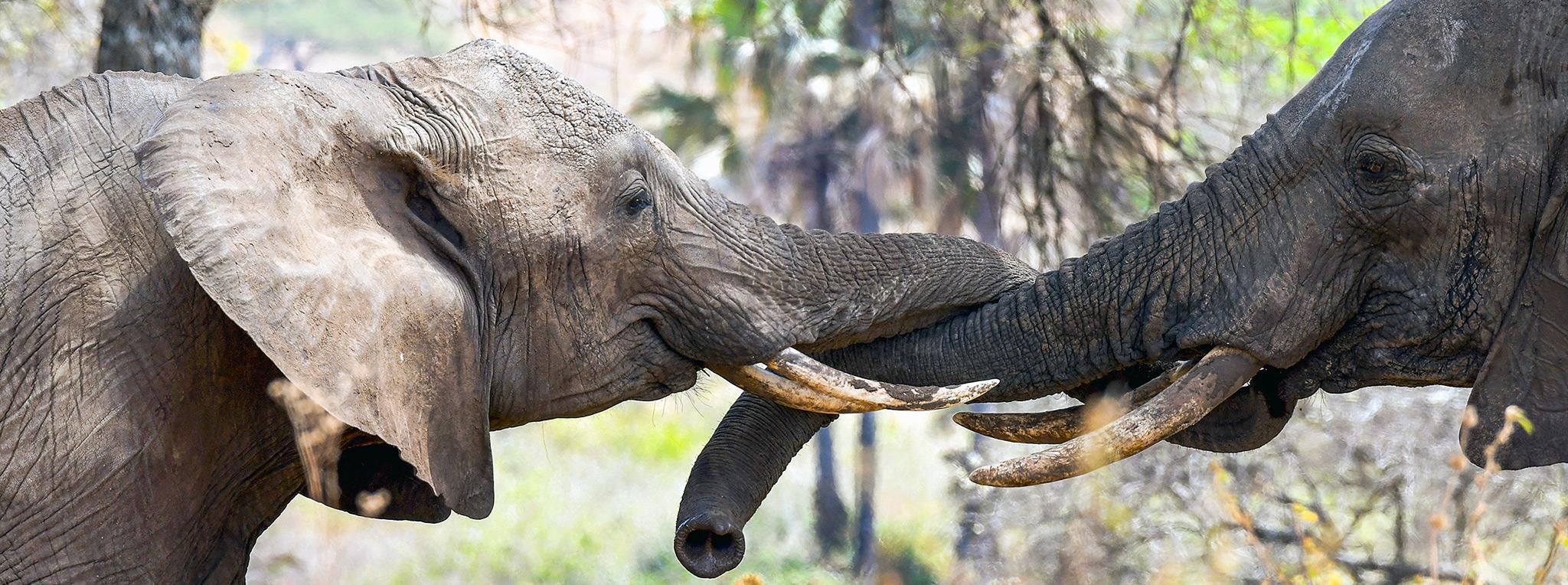
Among the highlights of South African wildlife are the iconic Big Five. While all species of the Big Five can be seen in the Greater Kruger National Park, certain destinations are renowned for quality sightings of the respective members of this esteemed group.
Lion
The most abundant concentration of lions in South Africa is in the Greater Kruger National Park, incorporating the park itself and the neighbouring Sabi Sands and Timbavati Private Reserves.
The latter reserve is home to the famous white lions, with snow white cubs are born every few generations, thanks to a recessive gene in the local population. Within this vast area, there are approximately 2,300 individuals.
Outside of Kruger, there are also wild lions in Kgalagadi, Madikwe and Pilanesberg National Park (Northwest), Hluhluwe-iMfolozi Park, Addo Elephant National Park and numerous private reserves dotted across the country.
Leopard
Without question, the best place in South Africa (and arguably the world) to see these elusive predators is the Sabi Sands Private Game Reserve.
Since the inception of the reserve, the various property owners have gone to great lengths to ethically habituate these often-shy cats.
Consequently, the various lodges boast a ridiculously high success rate for leopard sightings, attracting tourists, wildlife photographers and filmmakers from across the globe.
The southern Kruger National Park also boasts excellent leopard sightings, especially along the Sand and Sabie Rivers between Skukuza and Lower Sabie Rest Camps. Over 1500 leopards are believed to live in the Greater Kruger Park.
Elephant
As its name suggests, Addo Elephant National Park is a great place to see elephants and experience some of the finest South African wildlife; in fact, it is all but guaranteed that you will see many in a single game drive. The park is home to approximately 600 individuals within a relatively small area.
The Kruger National Park also has a very substantial population of approximately 31000 elephants, making it among the top five national parks in Africa to see elephants. Similarly, visitors to the Sabi Sands and Timbavati can also expect excellent sightings.
Pilanesberg and Madikwe also have healthy elephant populations, as do the iSimangaliso Wetland and Hluhluwe-iMfolozi Park.
Large bull elephants are a common sight in Kruger National Park, home to one of Africa’s largest elephant populations.
Rhino
The best national park to see both black and white rhinoceros in South Africa is Hluhluwe-iMfolozi Park in northern KwaZulu-Natal. The park was instrumental in the recovery of the white rhino back in the mid-20th century, as poaching threatened them with extinction.
More recently, with a resurgence in poaching activity, both black and white rhinos are being dehorned nationwide, in an effort to deter the practice.
The Greater Kruger National Park also has a good population of both species, particularly in the southern areas. You can also see rhinos in Pilanesberg, Madikwe and Addo Elephant Park.
Buffalo
During winter (May to September), the Timbavati Private Nature Reserve sees a huge influx of buffalo moving into the area in search of food and water, creating one of the most impressive spectacles in South African wildlife, with herds often numbering more than a thousand individuals.
The adjacent Kruger National Park and Sabi Sands Private Game Reserve also boast substantial buffalo populations throughout the year, with herds regularly seen moving to or from water. They are frequently preyed upon by lions in all three areas mentioned.
Visitors to Pilanesberg, Madikwe, Hluhluwei-iMfolozi Park, iSimangaliso and Addo can also look forward to great buffalo sightings.
ENDANGERED ANIMALS IN SOUTH AFRICA
Riverine Rabbit
Said to be among the rarest and most threatened mammals in the world, the riverine rabbit is now found only in limited regions of the Karoo.
The near-demise of the species was brought about by extensive habitat destruction from agriculture, in particular the clearing of their preferred dense riverine vegetation, for crops and grazing.
Riverine rabbits have a very low reproductive rate–producing only one offspring a year, further limiting the recovery of the population. Compounding matters further are habitat fragmentation and natural predation.
Today, population estimates suggest fewer than 500 individuals remain in the wild, placing riverine rabbits on the brink of extinction. Conservation Status: Critically endangered.
African Penguin
Once called the jackass penguin for its donkey-like bray, the African penguin is the only penguin species in Africa. They breed mainly on the islands and coastal areas of southwest Africa, notably at Boulders Beach, Cape Town.
Once abundant, their population collapsed due to overfishing, which reduced the supply of their preferred foods; sardines and anchovies. Additional pressure from oil spills, habitat disturbance and predation by gulls, seals and domestic animals further complicate conservation efforts.
Breeding colonies have shrunk drastically, with several having declined by over 60% in recent decades. Without urgent conservation interventions, they face extinction. Conservation status: Endangered.
African Wild Dog
Also known as the painted wolf, the African wild dog is one of Africa’s most endangered carnivores and one of the most threatened species of South African wildlife. Known for its highly social pack behaviour and gorgeous mottled coat, it once roamed widely across Africa.
The entire African population has been devastated by infectious diseases from domestic dogs, habitat fragmentation and human-wildlife conflict.
Packs require vast ranges, but expanding agriculture, fencing and settlements break up their range, reducing hunting success and exacerbating conflict with humans. With fewer than 6000 individuals roaming the wild, they are perilously close to extinction. Conservation status: Endangered.
Cheetah
The world’s fastest land mammal, the cheetah, symbolizes both grace and fragility in South Africa’s wild spaces. Once widespread, its numbers have also plummeted due to human-wildlife conflict and the loss and fragmentation of its historical range.
Cheetahs need expansive, open grasslands to hunt, but encroaching agriculture and fencing limit their movement and gene flow, leading to in-breeding and isolated populations. Additionally, livestock predation triggers persecution, while they are out-competed by other predators, both impacting survival rates.
Their survival now depends on protected reserves with managed metapopulations. Fewer than 7000 wild individuals survive, placing them on the brink of extinction. Conservation status: Vulnerable.
Geometric Tortoise
The geometric tortoise is a unique part of South African wildlife and one of the rarest reptiles on Earth. Found only in the Western Cape, it is highly sought-after by illegal collectors due to its distinctive and intricately patterned shell.
However, the biggest threat is habitat loss. Agriculture, urbanisation and invasive plant species have wiped out 90% of its preferred fynbos habitat.
Now living in small, fragmented populations, it is susceptible to the effects of climate change, especially wild fires, as they cannot easily move to new areas. Conservation efforts focus on protecting its remaining habitat from destruction and further fragmentation. Conservation status: Critically endangered.
LIST OF WILDLIFE IN SOUTH AFRICA - MAMMALS
Springbok – National Animal of South Africa
South Africa’s graceful national animal, the springbok, is renowned for its speed, agility and distinctive leap, known as “pronking”. In the semi-arid, open plains of the Karoo and Northern Cape, springboks thrive thanks to their ability to survive long periods without water.
They have a striking chestnut, white and tan coat, making them instantly recognisable. Springbok hold a deep cultural significance, famously lending their name to South Africa’s world-beating national rugby team.
Once heavily hunted, today, they flourish in protected reserves and private game farms, where large herds cavort across the savannah.
Whales
Up to 40 cetacean species frequent the coastal waters of South Africa, from the diminutive Heaviside’s dolphin to the massive blue whale. Of these, there are three key whale species, which are frequently seen.
Bryde’s whales can be seen year-round, particularly along the Garden Route and Eastern Cape. These slender whales reach lengths of 15 metres and feed on small fish.
Humpback and southern right whales migrate from the Antarctic to the South African coast between June and late-October, to give birth. Permitted whale watching boat tours offer close encounters. Recently, humpback whales have been recorded year-round off the Cape peninsula.
Meerkat
With their cute upright stances and frenetic lifestyle, meerkats are one of South Africa’s most charming and social creatures. They live in tight-knit groups, known as mobs, of up to 15 members.
Meerkats are found in semi-arid areas, including parts of the Garden Route and Route 62. As they are not easily seen in the wild, we suggest booking a meerkat interaction tour, if seeing them is a priority. Watching them emerge from their burrows to socialise at dawn is a beautiful experience.
Meerkats spend their day foraging for insects and small reptiles, while some act as sentinels, keeping a watchful eye for predators.
Kudu
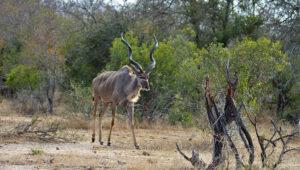
A large, stately antelope, the kudu is one of Africa’s most striking species. The males are instantly recognisable by their magnificent spiral horns and distinctive striped flanks. Kudus live in small herds of 10 – 20 animals, and can be seen in a variety of wooded habitats..
Kudus occur in most South African national parks, although they can be quite shy and elusive. When startled, they can leap two metres vertically from a standing start, and up to 3.5 metres high when in flight.
Kudus are browsers, feeding on a variety of leaves, flowers and fruits, allowing them to thrive over a wide area.
Hyena
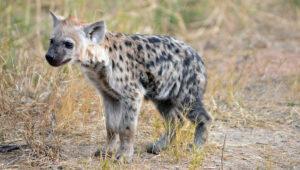
Two distinct species of hyenas are found in South Africa, the formidable spotted hyena and the elusive brown hyena.
Spotted hyenas are more widespread, living in most large national parks, from Kruger to Addo Elephant Park. They live in large, matriarchal clans and are equally adept as predators and scavengers. They are known for their powerful jaws and distinctive ‘laughing’ call.
By contrast, the brown hyena is a shyer, more solitary animal. They have a shaggy coat and live mainly as scavengers. They prefer drier habitats and you can see them in the parks of northwestern South Africa, including Kgalagadi Transfrontier, Madikwe and Pilanesberg National Park.
BIRDS IN SOUTH AFRICA
Blue crane
South Africa’s national bird is the blue crane, a symbol of peace and grace. It is easily identified by its elegant, pale blue-grey plumage, large head (with a pink bald patch) and long, trailing wing feathers.
They are often seen in pairs or small flocks in grasslands and agricultural areas. Prime locations for sightings of these elegant birds include the Overberg region inland from Hermanus, Route 62 and the Garden Route.
They are known for their elaborate courting rituals and loud, rattling calls, which are a characteristic sound in the otherwise still air of the countryside.
African fish eagle
One of the most evocative sounds of Africa is the call of the African fish eagle. This magnificent raptor is a striking bird, boasting an ice-white head and chest, dark brown body and powerful yellow talons.
They are commonly found near large bodies of fresh water, including lakes, dams and rivers. For visitors, they can be seen in most of the national parks in the country, from the Kruger in the north to the Garden Route National Park in the south.
If you’re lucky, you may get to see a fish eagle swoop down to snatch a fish from the water.
Lilac-breasted roller
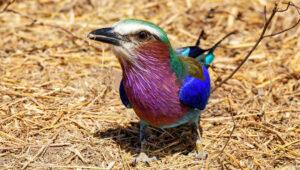
Whether it’s your first or fiftieth visit to the South African wilds, the sight of a lilac-breasted rollers is a feast for the eyes and a photographer’s dream. This bird is impossible to mistake, with no less than eight colours decorating its plumage, from bright lilac to turquoise.
Despite its splendid colouring, they are common resident in the country’s northeastern regions, including the Kruger National Park, where it seems there is one on every other tree.
As their name (roller) suggests, they are renowned for their acrobatic courtship flights. Less so for their surprisingly guttural call.
Knynsa turaco
Formerly known as the Knysna lourie, this gorgeous bird is an elusive and beautiful bird, heard more often than it is seen. Their most prominent features are a bright green-blue plumage, a crimson-tipped crest and a vivid red flash in its wings, which is only revealed in flight.
The eye has a distinctive orange ring. Should you hear their loud, grating call, keep a sharp lookout in the canopy for a chance to see one.
The Knysna turaco is a key species of the indigenous forest of the Garden Route, particularly around the towns of Knysna and Plettenberg Bay.
Cape gannet
One of South Africa’s most beautiful seabirds, the Cape gannet is known for its near-vertical dives and elegance in flight. They are a large, mostly white bird, with a black tail and wingtips. The head is a distinctive golden-yellow with a pale blue beak.
At sea, they form large flocks which literally ‘dive-bomb’ into shoals of fish from heights of 30 metres.
Like many seabirds, the population of Cape gannets is under immense pressure due to overfishing, with their population thought to have decreased by half over six decades. These gannets breed at only three islands on the South African coast.
DISCOVER EXCLUSIVE SOUTH AFRICA TOURS


OUR EXPERT ADVICE
DIVERSITY IS STRENGTH
The beauty of South Africa’s wildlife is in its diversity. Offering so much more than the Big Five, it is a country where you’re all but assured of amazing sightings of wildlife on land, in the air and at sea.
And, as they say, once the safari bug bites, it doesn’t let go.

Experience South Africa with us
Speak to one of our local advisors
x
Let's start planning your trip!
We will get back to you within 2 working days.